
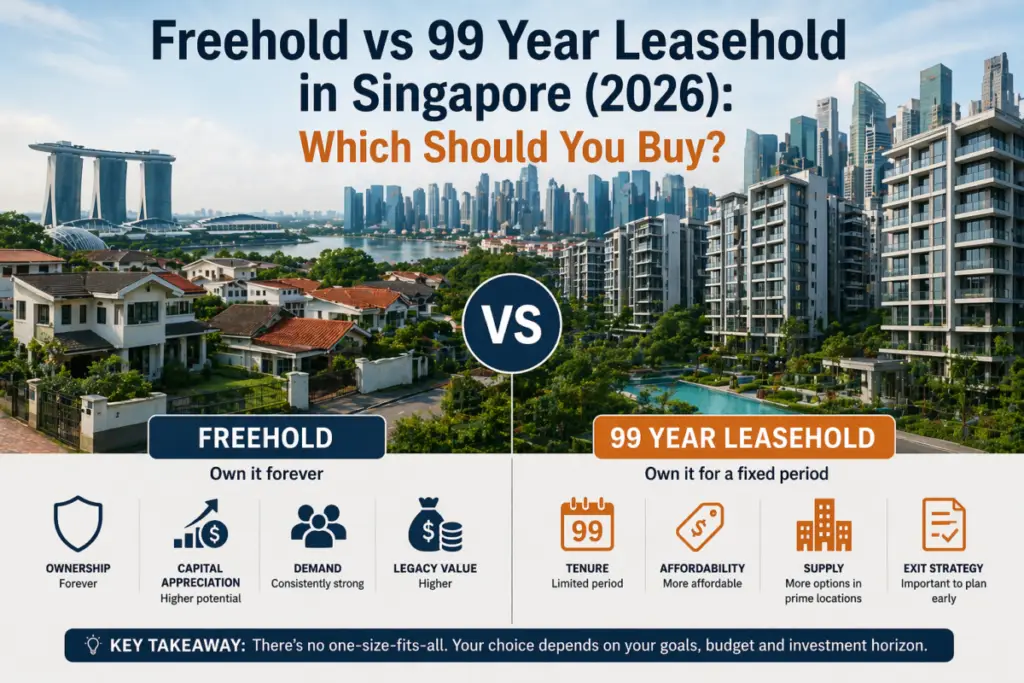
If you are planning to buy a condominium in Singapore, one of the first questions you will encounter is whether you should choose a freehold or a 99 year leasehold property. Many buyers assume that freehold is automatically the better option because it does not expire. However, in practice, tenure is only one part of the decision, and it should never be evaluated in isolation.
Direct answer: Freehold is not always better than 99 year leasehold in Singapore. For most buyers in 2026, location, entry price, layout, and holding period matter more than tenure. A strong leasehold project can outperform over the short to medium term when demand is high, while freehold can be more compelling for very long holds and scarcity value.
Compare like for like
Short, medium, long
Layout, MRT, schools
Resale buyer pool
Quick decision guide
- If you plan to hold under 7 years: a large freehold premium is often difficult to justify unless the unit is exceptional for its price.
- If you plan to hold 7 to 15 years: prioritise fundamentals. Many newer leasehold projects can perform strongly if demand is broad.
- If you plan to hold 15 years or more: freehold can become more compelling, provided the premium is not excessive and the project is desirable.
- If you are choosing for rental: location, MRT access, employment hubs, and facilities usually matter more than tenure.
- If you are unsure: compare 2 properties at the same price and choose the one with better location, layout, and buyer pool at resale.
Why tenure should not be evaluated in isolation
In 2026, the better choice depends on your budget, your intended holding period, and whether the property fits your lifestyle or investment objectives. To make a good decision, it helps to understand what tenure really means in Singapore and how it affects price, demand, and long term resale performance.
When you compare freehold and leasehold properties properly, you will often find that a well chosen leasehold unit can outperform a weaker freehold unit, especially over the short to medium term.
What freehold and 99 year leasehold mean
Freehold property means the ownership does not have a lease expiry, and the land tenure is indefinite. Freehold condominiums tend to be limited in supply and are often located in mature areas or prime districts. Because there are fewer freehold developments available, they may carry stronger scarcity value, which is why many buyers associate freehold with long term stability and legacy planning.
A 99 year leasehold property means the ownership is tied to a lease that lasts 99 years from the lease commencement date. Leasehold condominiums form a significant portion of Singapore’s private residential market, and many newer, larger developments fall into this category. These projects often have full facilities, modern layouts, and stronger mass market appeal, which can support both owner occupier and rental demand.
Price premium and value for money
Freehold properties usually come with a premium, and that premium can be substantial depending on location and attributes. A higher price does not automatically translate into better value. Some buyers pay more for freehold and compromise on size, layout efficiency, or convenience.
In many cases, the same budget could buy a larger unit in a newer leasehold project with better liveability and a broader resale buyer pool. This is why value often matters more than tenure, particularly for owner occupiers.
Development age and buyer appeal in 2026
Many freehold condominiums in Singapore are boutique projects or older developments. While some are excellent purchases, others may have limited facilities, smaller land plots, or less efficient layouts.
In contrast, many leasehold projects are newer, with modern designs, better facilities, and improved maintenance planning. This often translates into stronger rental demand and broader buyer appeal in the earlier years of ownership.
Holding period and lease decay
If you plan to hold for only a few years, the freehold premium may not be recovered on resale. Leasehold properties can perform strongly within the first 10 to 25 years of the lease if the project is well located and demand remains high.
Lease decay is frequently misunderstood. Leasehold properties do not suddenly lose value early in the lease. The market typically becomes more sensitive when the remaining lease becomes significantly shorter, particularly when buyer financing becomes more restrictive. What matters most is whether the property will still have a strong buyer pool when you plan to sell.
En bloc potential should be treated as a bonus
Some buyers consider en bloc potential as a reason to choose freehold. While freehold may have a stronger collective sale narrative, en bloc is never guaranteed. Factors include land value, plot ratio, market cycle conditions, and owner consensus. Leasehold developments can also go en bloc, so it is best to treat this as a bonus rather than a primary decision factor.
Conclusion
Tenure should be treated as one part of a broader decision, not the deciding factor by itself. In 2026, a strong leasehold condominium with the right attributes can outperform a weak freehold development, while a high quality freehold property can provide long term stability and scarcity value when purchased at the right price. The best approach is to buy based on value, demand, and your exit plan.
Frequently Asked Questions (FAQ)
Is freehold always better than 99 year leasehold in Singapore?
No. Freehold is not always better. In Singapore, location, entry price, and project quality can matter more than tenure, especially over the short to medium term. The better choice depends on holding period and whether the unit will still attract a strong buyer pool when you plan to sell.
Do 99 year leasehold condominiums lose value faster?
Not necessarily. Many leasehold condominiums perform strongly for years, particularly when they are newer and demand remains broad. Lease decay becomes more relevant only when the remaining lease is significantly shorter and financing becomes more restrictive for buyers.
Will banks give a lower loan for leasehold properties?
Usually not early in the lease. However, as the remaining lease reduces, some buyers may face tighter loan eligibility, which can affect resale demand. This is why lease age matters most when you plan your exit timeline.
Is it worth paying a premium for freehold in 2026?
It depends on the premium and the fundamentals. Freehold can be worth paying for if the unit has strong location, layout, and long term demand, and if you plan to hold for the long term. If the premium forces major compromises on size or convenience, it may not be good value.
Which is better for rental, freehold or leasehold?
Rental performance is driven more by location, facilities, and tenant demand than tenure. Many newer leasehold developments outperform older freehold projects for rental because they are closer to MRT stations or employment hubs and offer stronger facilities.
How do I decide between freehold and leasehold quickly?
Compare what you get for the same budget and choose the stronger fundamentals. If a leasehold unit offers a clearly better location, layout, and development quality, it can be the stronger purchase. If a freehold unit offers strong fundamentals without an excessive premium and suits a long holding period, it may be the better long term choice.