
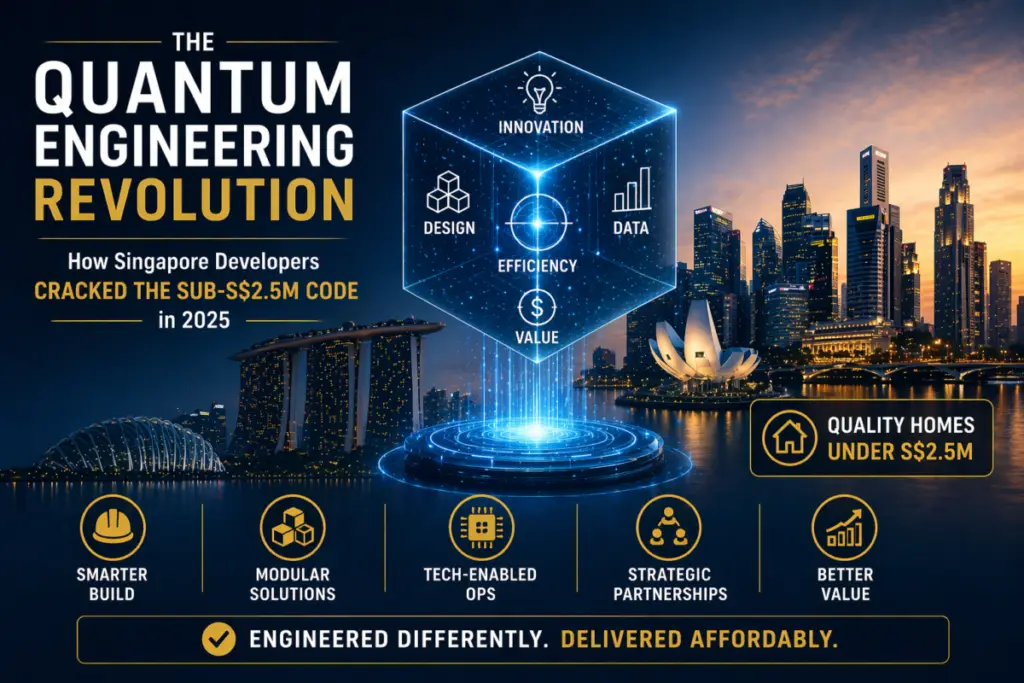
The Quantum Engineering Revolution: How Singapore Developers Cracked the Sub-S$2.5M Code in 2025
AsianPrime Property Blog • Annual Trend Analysis
The Quantum Engineering Revolution: How Developers Cracked the Sub-S$2.5M Code and Reshaped Singapore’s New Launch Market
If there was one defining strategy that separated the winners from the rest in Singapore’s 2025 property market, it was quantum engineering – the deliberate design of smaller, more efficient unit layouts to keep total prices below the psychological S$2.5 million threshold. This approach powered near-sellout launches from suburban Sembawang to prime Orchard Boulevard, reshaping how developers price, design, and market new homes across every segment.
What Is Quantum Engineering?
In Singapore’s property lexicon, “quantum” refers to the total price of a unit – not the per-square-foot rate. Quantum engineering is the developer practice of adjusting unit sizes, layouts, and configurations to ensure that the majority of units in a project fall below a target total price, typically S$2.5 million for mass-market and city-fringe projects, and S$3 million for prime-district launches.
This isn’t simply about building smaller homes. The most successful developers in 2025 combined compact footprints with efficient space planning – reducing corridor waste, optimising bathroom placement, and introducing flexible living-dining configurations – to deliver homes that feel larger than their square footage suggests. The result: higher psf rates that nevertheless translate into lower monthly mortgage payments and accessible down payments for the broadest possible buyer pool.
The 2025 Evidence: Project by Project
The data from March 2025 through February 2026 tells a compelling story. Projects that executed quantum engineering effectively achieved dramatically higher take-up rates than those that didn’t – regardless of location or market segment.
| Project | Region | Median PSF | Take-Up | Key Quantum Strategy |
|---|---|---|---|---|
| LyndenWoods | OCR | S$2,463 | 96.5% | Sub-S$2.5M suburban |
| Springleaf Residence | OCR | S$2,166 | 94% | Mass-market MRT proximity |
| Skye at Holland | CCR | – | 99% | CCR priced near RCR levels |
| Penrith | RCR | S$2,791 | 97% | Value vs RCR peers |
| River Green | CCR | S$3,111 | 86% | Smaller layouts, sub-S$2.5M quantum |
| Newport Residences | CCR | S$3,070 | 54%* | 75% of units under S$2.5M |
| Faber Residence | OCR | S$2,149 | 87% | Affordable suburban entry |
*Newport Residences: launch month take-up; continued selling strongly in subsequent months
Why S$2.5 Million Is the Magic Number
The S$2.5 million threshold isn’t arbitrary – it sits at the intersection of several critical buyer constraints. For a typical dual-income Singapore household earning S$15,000–S$18,000 monthly, a S$2.5 million purchase translates into a manageable Total Debt Servicing Ratio (TDSR) with standard 75% loan-to-value financing. It also aligns with CPF usage limits and represents a price point where stamp duty costs remain proportionate to the purchase.
Developers who understood this dynamic – and designed their product around it – consistently outperformed. The market’s message throughout 2025 was clear: price the product for the buyer pool, not for the land cost. Projects that attempted to push quantum above S$3 million in non-prime locations struggled with take-up, while those that engineered quantum below S$2.5 million – even at premium psf rates – achieved near-instant sellouts.
What This Means for 2026 Buyers and Investors
The quantum engineering trend shows no signs of reversing. With land costs continuing to rise and developers committed to maintaining sales velocity, the 2026 launch pipeline is expected to feature even more aggressively optimised unit sizes and layouts. For buyers, this creates both opportunity and risk.
The opportunity is clear: quantum-engineered units in desirable locations offer accessible entry points into neighbourhoods that were previously reserved for higher-budget buyers. A S$2.4 million unit at a prime-district freehold address represents genuine value creation.
The risk lies in resale. When the time comes to sell, these compact units will compete against other compact units in the same development and nearby projects. Buyers should carefully evaluate whether a unit’s layout, orientation, and floor level will differentiate it in a future resale market populated by similar-sized homes.
Frequently Asked Questions
What is quantum engineering in Singapore property?
Quantum engineering is the developer practice of designing unit sizes and layouts to keep total prices below psychological thresholds, typically S$2.5 million. This involves compact, efficient floor plans that achieve high psf rates while maintaining accessible total prices for the broadest buyer pool.
Why is S$2.5 million the key price threshold?
S$2.5 million aligns with TDSR limits for typical dual-income households, CPF usage caps, and proportionate stamp duty costs. Projects priced predominantly below this threshold consistently achieved 85–99% take-up rates in 2025.
Which projects best demonstrated quantum engineering in 2025?
River Green (CCR, S$3,111 psf, 86% take-up), Skye at Holland (CCR, 99% take-up), Springleaf Residence (OCR, S$2,166 psf, 94% take-up), and Newport Residences (CCR, S$3,070 psf, 75% of units under S$2.5M) all exemplified successful quantum engineering strategies.
Should buyers be concerned about compact unit sizes?
Buyers should evaluate layout efficiency, natural light, and view quality rather than pure square footage. Well-designed compact units can outperform larger units on rental yield and resale velocity. However, stress-test affordability against higher mortgage rates and consider long-term livability for your household size.
Source: AsianPrime Properties annual trend analysis based on URA developer sales data, March 2025 to February 2026.

Considering a new launch?
Launch pricing only makes sense against nearby comparables. Tell me which project you are looking at and I will line it up against what is actually selling in the area.