
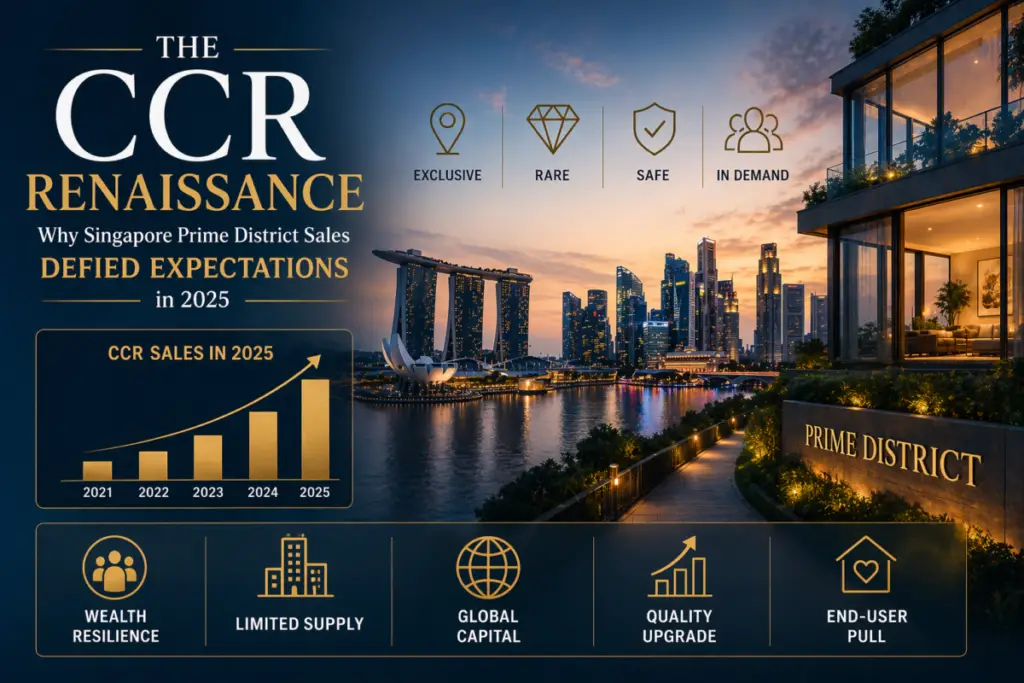
The CCR Renaissance: Why Singapore’s Prime District Sales Defied Expectations in 2025
Property Blog | Market Trend Analysis | 22 April 2026
From Districts 9 and 10 penthouses to Sentosa Cove waterfront villas, Singapore’s Core Central Region defied expectations in 2025 with a striking rebound in transaction volumes and prices. This trend analysis draws on a full year of AsianPrime newsletter data to unpack what drove the CCR’s revival and whether the momentum can hold into 2026.
The CCR Renaissance: How Prime District Sales Staged a Dramatic Comeback and What It Means for Buyers
Conventional wisdom heading into 2025 suggested that Singapore’s Core Central Region (CCR) would remain subdued – weighed down by the 60% Additional Buyer’s Stamp Duty on foreign purchasers and elevated psf pricing. The reality couldn’t have been more different. From River Green’s 86% take-up in July to Skye at Holland’s near-perfect 99% absorption in October, the CCR delivered some of the year’s most spectacular launch results, driven by a structural shift that reshaped the prime-district value proposition.
The Numbers Tell the Story
The CCR’s transformation across the year was dramatic. In June 2025, just 14 units sold in the prime district. By July, that number surged to 357 – a 2,450% increase – as Upperhouse at Orchard Boulevard and The Robertson Opus launched. August saw CCR volumes climb further to 513, and October’s Skye at Holland launch propelled the CCR to 724 units – the highest monthly volume in years.
Even during the quietest months, the CCR showed remarkable resilience. River Green continued selling at S$3,201 psf during September’s Hungry Ghost Month lull. Newport Residences topped the sales charts in both January and February 2026 at S$3,059–S$3,070 psf. These weren’t just launch-day spikes – they were sustained, month-over-month sell-through patterns that signalled genuine structural demand.
| Month | CCR Units | Key CCR Project | Take-Up / Price |
|---|---|---|---|
| Jul 2025 | 357 | Upperhouse, Robertson Opus | S$3,259–S$3,359 psf |
| Aug 2025 | 513 | River Green | 86% take-up, S$3,111 psf |
| Oct 2025 | 724 | Skye at Holland | 99% take-up |
| Jan 2026 | 162 | Newport Residences | 54% launch, S$3,070 psf |
| Feb 2026 | 63 | Newport Residences | +152% YoY despite CNY |
The Price Gap That Changed Everything
Perhaps the most consequential data point of 2025 was the narrowing CCR-RCR price gap. In September, the median unit-price gap between new non-landed homes in the CCR and RCR was approximately 27%. By October, following Skye at Holland’s launch, that gap had collapsed to just 2.2%.
This convergence was transformative. When a prime-district address costs only marginally more than a city-fringe alternative, the rational buyer calculus shifts decisively toward the CCR. Prime locations offer superior long-term capital appreciation, stronger rental demand from expatriates and professionals, and prestige value that appreciates with scarcity. At a 2% premium over RCR, these advantages come essentially free.
Developers understood this dynamic and priced accordingly. Rather than testing the upper limits of CCR pricing, successful launches – River Green, Skye at Holland, Newport Residences – deliberately positioned themselves at or near RCR price levels, attracting upgraders who might otherwise have settled for a city-fringe address. The strategy worked spectacularly.
Local Buyers Drive the Renaissance
A key misconception about the CCR is that it depends on foreign buyers. The 2025 data definitively disproved this. With the 60% ABSD continuing to deter most non-resident purchasers, the CCR’s revival was powered overwhelmingly by Singaporean citizens and permanent residents – upgraders moving from the RCR and OCR, high-net-worth locals consolidating property holdings, and young professionals entering the prime market through quantum-engineered compact units.
This domestic buyer base proved to be more resilient and price-sensitive than the foreign buyers of previous cycles. They responded to value – not prestige alone – and rewarded developers who delivered genuine affordability in prime locations. The result was a healthier, more sustainable CCR market less vulnerable to policy shifts and geopolitical disruption.
What This Means for 2026 and Beyond
The CCR renaissance is unlikely to reverse in 2026. Several projects in prime precincts are scheduled for launch, and developers have clearly absorbed the lesson of 2025: price for the local buyer pool, not the foreign premium. If mortgage rates remain contained and employment conditions stay supportive, prime-district demand should remain resilient.
The main risk to watch is supply clustering. If multiple CCR launches arrive simultaneously, competition could temporarily soften take-up rates and pressure developers to offer more attractive pricing – a scenario that would benefit buyers but test developer margins. Conversely, if the pipeline remains measured, the scarcity premium on well-located CCR freehold sites will continue to support pricing.
Frequently Asked Questions
Why did Singapore’s CCR property market outperform in 2025?
The CCR benefited from a narrowing price gap with the RCR (from 27% to just 2.2%), quantum-engineered pricing that attracted local upgraders, and strong project execution at launches like Skye at Holland (99% take-up), River Green (86%), and Newport Residences.
Is the CCR still dependent on foreign buyers?
No. The 2025 data showed that Singaporean citizens and permanent residents drove the CCR renaissance, with the 60% ABSD effectively deterring most foreign purchasers. This domestic-driven demand proved more resilient and sustainable.
What caused the CCR-RCR price gap to narrow?
Developers deliberately priced CCR launches at or near RCR levels to attract the broadest buyer pool. Compact unit designs kept total quantum accessible, making prime-district addresses available at marginal premiums over city-fringe alternatives.
Should buyers consider CCR properties in 2026?
The CCR offers compelling value for buyers with 7–10 year horizons, particularly freehold sites in established neighbourhoods. The narrow price gap with RCR means buyers can access prime-district addresses with superior long-term appreciation potential at relatively modest premiums.
Source: AsianPrime Properties annual trend analysis based on URA developer sales data, March 2025 to February 2026.

Thinking about where to buy or hold?
Market conditions matter, but what counts is how they apply to your property and your timeline. Happy to give you a straight read on your situation.