
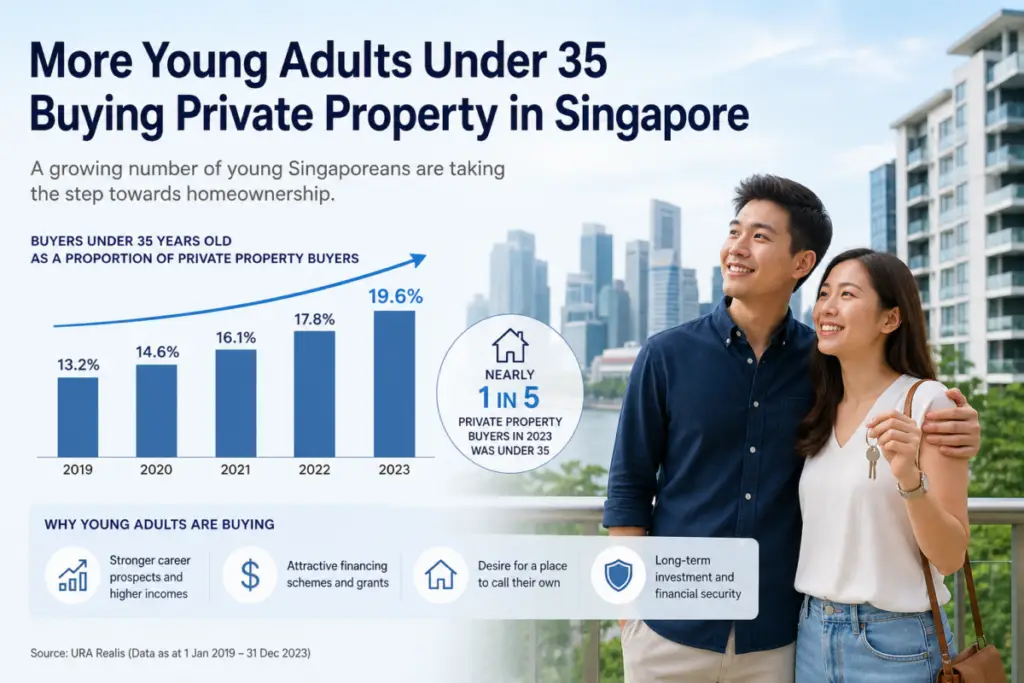
More Young Adults Under 35 Buying Private Property in Singapore – Some as Investment
Data from Singapore’s three major local banks – DBS, UOB and OCBC – reveals a growing number of young adults under 35 entering the private property market, with home loan volumes for this age group rising steadily. Between 2024 and 2025, DBS reported a 40 per cent jump in home loans taken by borrowers under 35, while OCBC saw a 36 per cent increase in singles purchasing private properties for investment in 2025.
Under-35 Loans (DBS)
Singles Investing (OCBC)
OCBC Buyers Are Single
Avg Loan Quantum (UOB)
Banks See a Clear Shift in Young Borrower Activity
UOB has seen a growing number of customers aged 35 and below taking up home loan packages, with loan volumes in this segment growing by more than 15 per cent year on year since 2023. The average loan quantum for this group has also risen by about 5 per cent annually between 2023 and 2025, surpassing the S$1 million mark.
At OCBC, singles made up one in three of the bank’s new home loan customers who bought private property in 2025, with about 20 per cent of singles buying for investment. Of these single investors, around a quarter were under the age of 30.
Many of these young borrowers tend to favour new launches, with three in five opting for properties under construction. OCBC also reported that it financed more than a third of total private property market transactions in 2025, giving it a broad view of the trend.
AsianPrime Insight: The data confirms what we see on the ground – young professionals are increasingly treating property as a wealth-building tool rather than just a place to live. Progressive payment schemes for new launches make it easier for under-35 buyers to pace their cash flow while building equity in an appreciating asset.
Case Study: From Wall Street to Marina Bay to Ulu Pandan
The article profiles Ms Teri Tan, who at 28 paid about S$1.25 million for a one-bedroom unit of about 678 sq ft at The Sail @ Marina Bay in 2021. Working as an investment banker on Wall Street at the time, she leased the unit out for S$4,800 a month for over a year.
After returning to Singapore in December 2022, she lived in it briefly before leasing it out again. In January 2025, she sold the unit for about S$1.25 million – roughly the same price she paid. She then bought a two-bedroom-plus-study unit of about 800 sq ft at Pinetree Hill in Ulu Pandan for S$2.1 million, expected to be ready in Q3 2026.
Both purchases were primarily for investment. Ms Tan, now 32, currently lives in a rented HDB flat in Boon Keng. She described her first purchase as an “ego purchase” – a unit in the CBD with a Marina Bay view. Over time, she learnt that an investment property should be based on what the market wants, not personal preference, which shaped her decision to buy at Pinetree Hill where proximity to schools, tenant demand and longer-term holding value were the priority.
AsianPrime Insight: Ms Tan’s journey illustrates a common learning curve. First-time investor buyers often gravitate towards lifestyle locations, but the best rental yields and capital appreciation typically come from properties near schools, transport nodes and established tenant pools. We always advise clients to separate their lifestyle aspirations from their investment criteria.
Rising Rents Push Young Buyers to Own
Another buyer, Ms Hilda Tan, bought her first property at 29 while earning over S$100,000 a year as a business development manager. She paid S$910,000 for a 635 sq ft condo unit at Waterfront Isle in Bedok Reservoir in December 2023.
Having lived independently since 2012, she said rising rents pushed her to consider buying. By 2023, the rental market was at fever pitch – even tiny rooms in inconvenient locations were seeing rents double overnight. When she ran the numbers, paying a mortgage made far more sense.
After relocating to Hong Kong for work in 2025, she rented the unit out for S$3,200 a month. She noted that the actual returns are moderated by ongoing costs such as maintenance fees and sinking fund contributions – a practical lesson in accounting for the hidden costs of property ownership beyond just the mortgage.
AsianPrime Insight: The rent-versus-buy calculation has shifted decisively for many young professionals earning above S$80,000. With rental yields for well-located suburban condos at 3.5 to 4.5 per cent and mortgage rates around 2.5 to 3 per cent, the numbers often favour ownership – especially when you factor in capital appreciation over a five to ten year horizon. We help clients run these numbers before they commit.
Joint Purchases and the Risks to Watch
Joint purchase arrangements are becoming more common as younger buyers pool resources to enter the private property market early. One buyer in the article bought a resale EC in Yishun with her partner in 2022 for S$1.1 million. But when the relationship ended, she decided to buy over her partner’s share – taking on the mortgage alone and facing a fresh four-year lock-in period before she can sell.
Market observers say such arrangements come with risks. Misaligned long-term objectives can lead to disputes if one party wishes to exit while another prefers to hold. Buyers are also jointly liable for the mortgage, meaning one party may have to shoulder repayments if the other defaults. Changes in life stages can further complicate matters, with later marriage potentially triggering additional stamp duties when purchasing another home.
Those who sell may also face a 15-month wait before purchasing a resale HDB flat or up to 30 months before applying for a Build-To-Order flat, adding practical constraints to exit timing.
AsianPrime Insight: We always advise clients considering joint purchases to have a clear exit agreement in writing before committing. Cover scenarios like relationship changes, one party wanting to sell, and how to handle the ABSD implications if either party buys again later. A little planning upfront can prevent very costly disputes down the road.
What the Banks Advise
Despite the bullish lending data, bankers urge caution. UOB advises that property is a relatively illiquid asset and a long-term financial commitment. Buyers should take a measured view, factor in the full costs of ownership, and consider how interest rate changes could affect monthly repayments over time.
OCBC recommends that investors should not rely solely on rental income. Borrowers should have at least six months of mortgage repayments in liquid assets as a buffer and should also factor in costs such as maintenance fees and property taxes.
Industry experts note that elevated prices have also accelerated inter-generational support, with some parents stepping in to help with upfront costs. While this broadens access to the market, it also means that some young buyers may be taking on commitments that depend on family financial backing rather than their own income trajectory alone.
AsianPrime Insight: Sound advice from the banks. We always stress-test our clients’ budgets at a higher interest rate scenario – typically 4 per cent – to make sure they can comfortably service the mortgage even if rates rise. Property should be a wealth builder, not a source of financial stress. Talk to us before you commit and we will help you build a plan that works for your income and goals.
Frequently Asked Questions
Are more young Singaporeans buying private property?
Yes. DBS reported a 40 per cent jump in home loans for under-35 borrowers between 2024 and 2025. UOB saw loan volumes in this segment grow over 15 per cent year on year since 2023, with the average loan quantum surpassing S$1 million.
Are young buyers purchasing for investment or to live in?
Both, but investment buying is rising. OCBC reported a 36 per cent increase in singles buying private property for investment in 2025. About 20 per cent of single buyers at OCBC purchased for investment, with a quarter of those under 30.
What are the risks of buying property under 35?
Key risks include over-leveraging relative to income, interest rate increases affecting repayments, hidden ownership costs like maintenance fees and taxes, and complications from joint purchases if relationships change. Banks recommend keeping at least six months of repayments in liquid assets.
Should young buyers prefer new launches or resale?
Three in five young borrowers at OCBC opted for new launches under construction, attracted by progressive payment schemes that spread cash outflows. However, resale units offer immediate rental income and known neighbourhoods. The right choice depends on your cash flow profile, investment horizon and risk appetite.
Source: The Straits Times, 3 May 2026. This article has been rewritten and adapted by AsianPrime Properties for educational and informational purposes.

Thinking about where to buy or hold?
Market conditions matter, but what counts is how they apply to your property and your timeline. Happy to give you a straight read on your situation.