
What the New EC Cooling Measures Mean for Buyers, Upgraders, and the Market
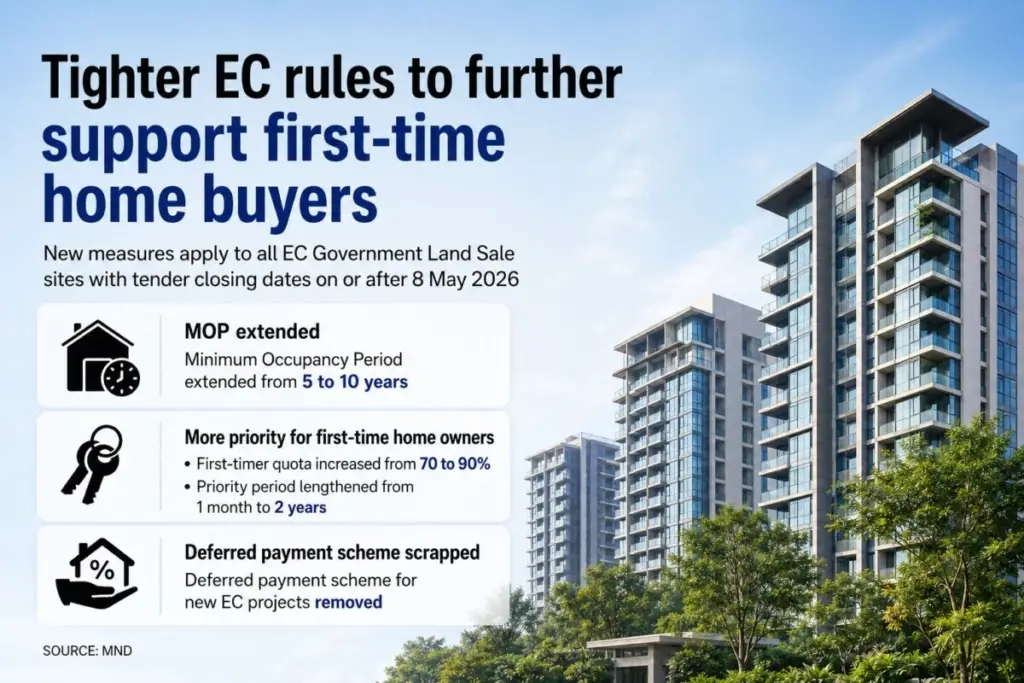
The government’s announcement on 8 May 2026 of sweeping changes to the executive condominium (EC) scheme marks the most significant tightening of EC rules since the housing type was introduced in 1995. With the MOP doubled to 10 years, first-timer quota raised to 90 per cent, and deferred payments scrapped, every segment of the EC market will be affected. Here is our analysis of what these changes mean for different buyer profiles and the broader property landscape.
MOP Doubled
First-Timer Quota
Priority Period
EC Price Surge Since 2015
The 10-Year MOP: A Game-Changer for Flipping
The doubling of the MOP from five to 10 years is the centrepiece of the new measures. Between 2021 and 2025, about 75 per cent of ECs that were transacted on the open market were sold within five years after their MOP, up from 45 per cent in the preceding five-year period. The top EC resale deals in Q1 2026 recorded gains of 130 to 140 per cent, with sellers regularly pocketing over S$1 million in gross profit.
By extending the holding period to a full decade, the government is fundamentally altering the investment calculus. Buyers can no longer purchase an EC with a realistic expectation of flipping it for a quick profit at the five-year mark. The 10-year lock-in forces buyers to treat ECs as genuine long-term homes rather than medium-term investment vehicles, and the uncertainty of property market conditions over a decade makes speculative buying far riskier.
AsianPrime Insight: The 10-year MOP effectively removes the “buy-hold-flip” strategy that made ECs one of the most profitable property plays in Singapore. For buyers who genuinely intend to live in their EC for the long term, this is a neutral change. But for those who viewed ECs primarily as an affordable entry point to the private market with a built-in exit timeline, the extended MOP significantly diminishes that appeal. We expect this to redirect some demand toward resale condos and new launches in the Outside Central Region, where there is no MOP restriction.
DPS Removal Hits HDB Upgraders Hardest
The scrapping of the deferred payment scheme will have an outsized impact on HDB upgraders, who form a significant portion of EC buyers. Under DPS, buyers paid just 20 per cent upfront and deferred the remaining 80 per cent until the project obtained its temporary occupation permit, typically at a 2 to 3 per cent premium. At the last two EC launches, Rivelle Tampines and Coastal Cabana, more than 75 per cent of buyers opted for the deferred payment scheme.
Without DPS, HDB upgraders who still have an outstanding mortgage will now need to service two loans simultaneously during the construction period, which typically spans three to four years. This dual-loan burden could strain household finances and may push some upgraders to reconsider the timing of their purchase, or explore alternative housing options altogether.
AsianPrime Insight: The DPS removal is arguably the measure with the most immediate impact on buyer behaviour. For HDB upgraders carrying an existing loan, the financial planning becomes significantly more complex. We advise clients in this situation to work through the numbers carefully: calculate the overlap period, assess total debt servicing ratio (TDSR) implications, and consider whether selling the HDB flat before purchasing the EC might be more prudent. For some, the private resale condo market may now offer a more straightforward upgrade path without the MOP and DPS constraints.
First-Timer Quota: Good News for Young Couples
The increase in the first-timer quota from 70 to 90 per cent, combined with the extension of the priority period from one month to two years, is unambiguously positive for young married couples and families buying their first home. In 2020, about half of EC buyers were first-timers. By 2024 and 2025, that proportion had dropped to between 30 and 40 per cent, as second-timers with larger budgets from the sale of their first homes increasingly dominated the buyer pool.
With 90 per cent of units now reserved for first-timers during the first two years, second-timers will find it much harder to secure EC units. Developers will also need to price with first-timer budgets in mind, since they must sell 90 per cent of units to this segment within the ABSD clawback window. This should exert downward pressure on both land bids and launch prices.
AsianPrime Insight: This is the most positive aspect of the new measures for the segment the EC scheme was originally designed to serve. Young couples earning up to S$16,000 per month who have been priced out by wealthier second-timers will now have a genuine shot at securing a unit. We expect developers to adjust their product mix accordingly, potentially offering smaller unit types and more competitive pricing to appeal to first-timer budgets. If you are a first-timer considering an EC, the upcoming launches at Senja Close, Woodlands Drive 17, Sembawang Road, and Miltonia Close are worth watching closely, as they are not affected by the new rules and may see a rush of demand.
Market Impact: Land Bids, Pricing, and Alternatives
EC land prices had reached record highs before the announcement, with bids for two Woodlands plots hitting S$782 psf ppr in August 2025 and S$794 psf ppr in January 2026. Median new EC prices surged 120 per cent from S$797 psf in 2015 to S$1,754 psf in 2025, compared to a 51 per cent increase in median HDB resale prices over the same period. As at 26 April 2026, new ECs traded at a median of S$1,843 psf versus S$2,278 psf for new OCR 99-year non-landed private homes.
With the new restrictions, developers are expected to bid more conservatively for EC sites, which should translate into lower launch prices for buyers. The first two affected sites are at Canberra Drive (May tender) and Sembawang Drive (June tender). NUS Professor Sing Tien Foo noted that developers will need to account for the 10-year MOP resale restriction when calibrating their bids, as this diminishes the perceived value proposition for buyers relative to private condominiums with no MOP.
AsianPrime Insight: The narrowing price gap between ECs and OCR private condos has been one of the key concerns driving this review. At S$1,843 psf versus S$2,278 psf, the difference is only about 19 per cent, yet ECs come with income ceilings, MOP restrictions, and now much tighter resale rules. For buyers near the S$16,000 income ceiling, a private condo in the OCR may now represent better value when you factor in the flexibility of no MOP, no nationality restrictions on resale, and the ability to rent out immediately. We encourage our clients to compare both options side by side before committing.
Frequently Asked Questions
Should I still buy an EC after these changes?
ECs remain a viable option if you are a first-time buyer genuinely planning to live in the unit for at least 10 years. The 90 per cent first-timer quota and expected downward pressure on prices work in your favour. However, if your primary motivation was to flip for profit after the five-year MOP, you should reconsider.
How does the DPS removal affect my finances as an HDB upgrader?
Without the deferred payment scheme, you will need to make progressive payments during construction while potentially still servicing your HDB mortgage. This means a period of dual-loan obligations. Calculate your Total Debt Servicing Ratio (TDSR) carefully and consider whether selling your HDB flat first might be more prudent.
Are there any EC launches not affected by the new rules?
Yes. Five upcoming EC launches at Senja Close, Woodlands Drive 17, Sembawang Road, and Miltonia Close will not be affected as their site tenders have already closed. These may see strong demand from buyers wanting to purchase under the old rules.
Is a private condo now a better option than an EC?
For buyers near the S$16,000 income ceiling, a private condo in the Outside Central Region may offer better value when factoring in no MOP, no nationality restrictions on resale, and the ability to rent out immediately. The price gap between ECs (S$1,843 psf) and OCR private condos (S$2,278 psf) has narrowed to about 19 per cent.
Will EC prices fall because of these measures?
Developers are expected to bid more conservatively for EC land, which should translate into lower launch prices. However, the five upcoming unaffected launches may still see strong pricing as buyers rush to secure units under the old rules. The full impact on pricing will become clearer when the first affected projects at Canberra Drive and Sembawang Drive are launched.
Source: The Business Times and The Straits Times, 8 May 2026. This article has been rewritten with professional commentary by AsianPrime Properties for educational and informational purposes.

Buying or selling an HDB flat?
Whether it is a BTO application, a resale purchase or timing your sale, I can pull recent transactions for your block and give you an honest read on where you stand.