
Opinion: En Bloc Changes Will Spur More Redevelopment of Ageing Condos and Optimise Land Use
Opinion & Analysis | August 11, 2026
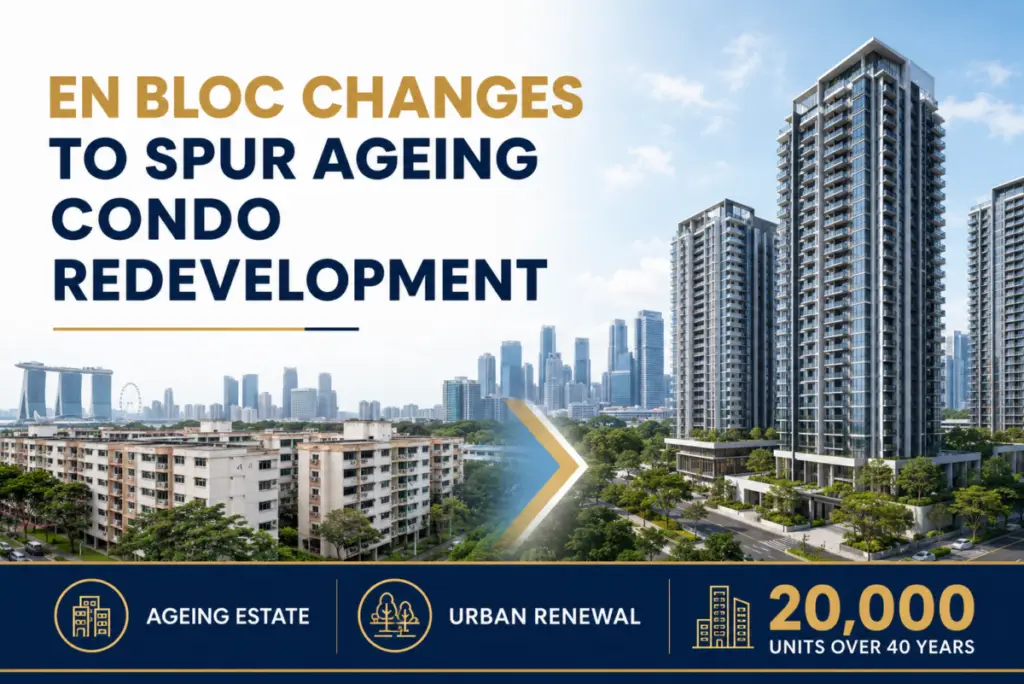
The government’s proposed changes to en bloc consent thresholds and ABSD timelines are set to unlock a more vibrant collective sale market. With around 20,000 private non-landed residential units now over 40 years old and ageing stock rising, the reforms create conditions for large-scale urban renewal that could yield significantly more homes on existing land parcels while raising sustainability considerations.
New Consent Thresholds
Units Over 40 Years
Tan Boon Liat Sale
Pine Grove Potential
Lower Thresholds and Extended ABSD Timelines
Under the proposed Land Titles (Strata) (Amendment) Bill, the consent threshold for developments aged 40 to 59 years will be lowered from 80 to 70 per cent, and from 80 to 65 per cent for those aged 60 years and above. The existing requirements of 90 per cent for developments less than 10 years old, and 80 per cent for those between 10 and 39 years, remain unchanged.
The collective sale regime will also be extended to non-strata-titled private residential developments where flat owners hold long leases but do not own the underlying land, such as Neptune Court and Orchard Court.
On the developer side, ABSD remission timelines have been extended: to six years for sites yielding 700 to 1,400 homes, and to seven years for sites yielding at least 1,400 units. However, developers must sell a minimum of 50 per cent of homes by the end of six years.
Optimising Land Use: The Pine Grove Example
Currently, there are around 20,000 private non-landed residential units more than 40 years old, and this number will continue to rise as the Republic’s private housing stock ages. Redeveloping housing en bloc sites can help optimise land use in land-scarce Singapore.
Take Pine Grove, a development with 660 units that is over 40 years old. Should it be sold en bloc and redeveloped, a new development might yield over 2,000 units, or more than three times the existing number of homes. More homes are needed amid rising household formation, with more young married couples and singles wanting their own home, while many seniors are living alone.
Many owners of units at ageing condo developments will be happy to divest more easily via a collective sale. After all, a development 50 or 60 years old might be reeling from much wear and tear, in dire need of costly building improvement works to make the living environment more pleasant.
Sustainability and the Case for Adaptive Reuse
While the benefits of en bloc redevelopment are clear, the opinion piece raises an important counterpoint: demolishing old buildings that are structurally sound could be sub-optimal from an environmental viewpoint. In the redevelopment of en bloc sites, developers should be offered strong incentives to put existing old buildings to new uses wherever possible.
The sale of the Golden Mile Complex along Beach Road for S$700 million marked the first collective sale of a large strata-titled development as a conserved building, setting a precedent. In that case, the economics for the new owners were helped by URA providing incentives including an increase in floor area with a waiver of part of the development charge.
Through the years, Singapore has done well in meeting its residents’ housing aspirations, excelling in optimising land use to meet growing and evolving needs. Let us welcome active redevelopment of old private non-landed residential developments, with such work carried out sensitively, including by imaginatively repurposing old buildings to serve new purposes.
Frequently Asked Questions
What are the new en bloc consent thresholds?
For developments aged 40 to 59 years, the threshold drops from 80% to 70%. For those aged 60 years and above, it drops from 80% to 65%. The existing 90% (under 10 years) and 80% (10 to 39 years) thresholds remain unchanged.
How many private residential units are over 40 years old?
There are currently around 20,000 private non-landed residential units more than 40 years old in Singapore, and this number will continue to rise as the housing stock ages.
How does en bloc redevelopment optimise land use?
For example, Pine Grove with 660 units could yield over 2,000 units if redeveloped, more than tripling housing capacity on the same land. This helps address rising household formation and demand for more homes.
What about sustainability in en bloc redevelopment?
Demolishing structurally sound buildings raises environmental concerns. The Golden Mile Complex sale showed that conservation and redevelopment can coexist when developers are offered incentives such as additional floor area and development charge waivers.

Wondering if your development qualifies?
The lower consent thresholds change the arithmetic for a lot of ageing developments. Send me your project name and I will tell you where it stands, and what a realistic reserve price looks like.