
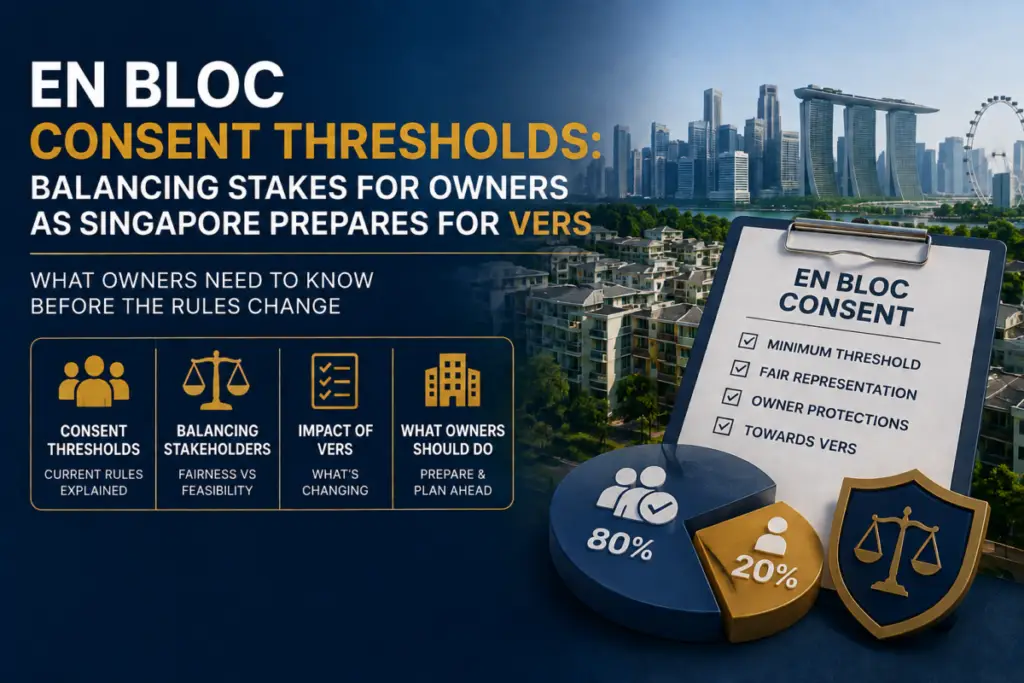
En Bloc Consent Thresholds: Balancing Stakes for Owners as Singapore Prepares for VERS
The Land Titles (Strata) Amendment Bill, introduced on 4 August 2026, lowers the consent threshold for collective sales from 80 per cent to 70 per cent for developments aged 40 to 59 years, and to 65 per cent for those 60 years and older. Writing in The Straits Times, Christopher Gee of the Institute of Policy Studies argues that the lessons from building consensus in private en bloc deals will matter far more when HDB’s Voluntary Early Redevelopment Scheme (VERS) arrives.
Threshold (40-59 yr)
Threshold (60+ yr)
CSC Requisition
Signature Window
New Thresholds Under the Strata Amendment Bill
The Bill lowers the consent threshold for a collective sale from 80 per cent of owners to 70 per cent for developments aged 40 to 59 years, and to 65 per cent for those 60 years and older. Thresholds for developments under 40 years remain unchanged at 80 per cent, with 90 per cent required for those between 10 and 39 years.
At the same time, the Bill raises the bar to start the process. Requisitioning a collective sale committee (CSC) will now need 35 per cent of owners’ support, up from the current 25 per cent, and the committee will have just six months to gather signatures, rather than 12.
“Taken together, the Bill demands a harder take-off, allows for an easier landing, but hands the whole flight a much shorter runway to do both in,” writes Christopher Gee, deputy director (research) and senior research fellow at the Institute of Policy Studies, National University of Singapore.
The Cost of Inaction
More than 20,000 private non-landed residential units in Singapore are already past 40 years old, with that number growing as the housing stock ages. Spalling concrete, ageing lifts and sinking funds that no longer keep pace with maintenance needs are everyday realities for many older developments today.
A collective sale is one of the few remaining mechanisms to renew housing stock and recycle scarce land effectively. The alternative is a long, expensive slide into disrepair as the property ages. Gee argues that inaction has a cost that is “diffuse, cumulative and less visible compared with the sharp signal of a failed vote.”
He cites the example of two ageing HDB blocks in Tiong Bahru that narrowly failed to secure the votes needed for the Home Improvement Programme, which requires 75 per cent household support, as a reminder that even subsidised enhancements are not free from the problems of collective action.
Owner Motivation: The Real Divide
Gee argues that the real divide in collective sales is not between freehold and leasehold tenure, but between owner motivations. Most owners treat their flat as both shelter and store of value simultaneously, a foundational bargain of Singapore’s home ownership model. The tension becomes acute when an en bloc vote forces these two functions apart.
A long-term owner-occupier, for whom the flat is principally shelter, tends to experience a decaying 99-year lease as a background fact, something to note rather than act on urgently. An investor, by contrast, reads that same clock differently, as a timer running against how many future buyers will still be able to finance a purchase by the time they want to exit.
He points to Pine Grove condominium, 42 years into its 99-year lease and on its fifth collective sale attempt. Its 660 units span long-tenured owner-occupiers, investor-landlords and overseas owners. “What stalls Pine Grove is not just the tenure clock but the sheer heterogeneity of its owner base,” he writes.
The Clock Ticks Unequally
Tenure shapes how sharply the clock divides owners. In leasehold developments, the new six-month signature window introduces a logistical barrier. For mega-estates like Braddell View with 918 units, tracing hundreds of owners, many residing overseas, within 180 days is a race against time, regardless of whether owners agree in principle.
The shorter window protects dissenters from prolonged pressure, but risks locking out willing sellers who simply cannot be reached in time. If thresholds alone cannot eliminate friction, the legitimacy of the outcome hinges on how conflict is managed before the CSC clock starts, including what happens to the minority once it loses.
In freehold developments, while the lease clock is absent, a different deadlock emerges around opportunity cost and capital appreciation. “Two developments could clear an identical 70 per cent threshold and leave very different feelings of grievance behind, depending on how much the dissenting owners felt their concerns were engaged along the way,” Gee writes.
Building Consensus Before VERS Arrives
Gee argues that the outcome depends less on voting thresholds and more on what a private estate’s management corporation does, or fails to do, before the en bloc clock starts running. He makes a case for management corporations strata title, or MCSTs, to conduct a structured, non-binding sentiment exercise before formal CSCs are requisitioned, surfacing where owners stand and why well before the formal process raises the stakes.
Looking ahead, he warns that HDB’s Voluntary Early Redevelopment Scheme (VERS), which allows owners of HDB flats aged 70 years or older to vote on whether the Government should buy back their homes before the 99-year lease expires, will eventually confront the identical design question at a far larger scale. The scheme is not expected to begin before the 2030s, and the VERS threshold has not been announced.
The Ministry of National Development has said remuneration will be less generous than the old Selective En bloc Redevelopment Scheme, where home owners did not have a choice. “Getting that right for a few hundred units in a private estate is difficult enough; getting it wrong for more than a million HDB households is a mistake Singapore cannot afford to make,” Gee concludes.
Frequently Asked Questions
What are the new en bloc consent thresholds?
The Land Titles (Strata) Amendment Bill lowers the consent threshold from 80 per cent to 70 per cent for developments aged 40 to 59 years, and to 65 per cent for those 60 years and older. Developments under 40 years remain at 80 per cent. The CSC requisition threshold rises to 35 per cent, and the signature window is shortened to six months.
How will the changes affect large estates?
For mega-estates like Braddell View with 918 units, the new six-month signature window could be a logistical challenge, as tracing hundreds of owners, including those overseas, within 180 days is a race against time. However, the lower consent thresholds may make it easier to reach the required majority once signatures are gathered.
What is VERS and how does it relate to en bloc reforms?
The Voluntary Early Redevelopment Scheme (VERS) will allow owners of HDB flats aged 70 years or older to vote on whether the Government should buy back their homes before the 99-year lease expires. The scheme is expected to begin before the 2030s and will face similar consensus-building challenges at a much larger scale than private en bloc sales.

Wondering if your development qualifies?
The lower consent thresholds change the arithmetic for a lot of ageing developments. Send me your project name and I will tell you where it stands, and what a realistic reserve price looks like.