
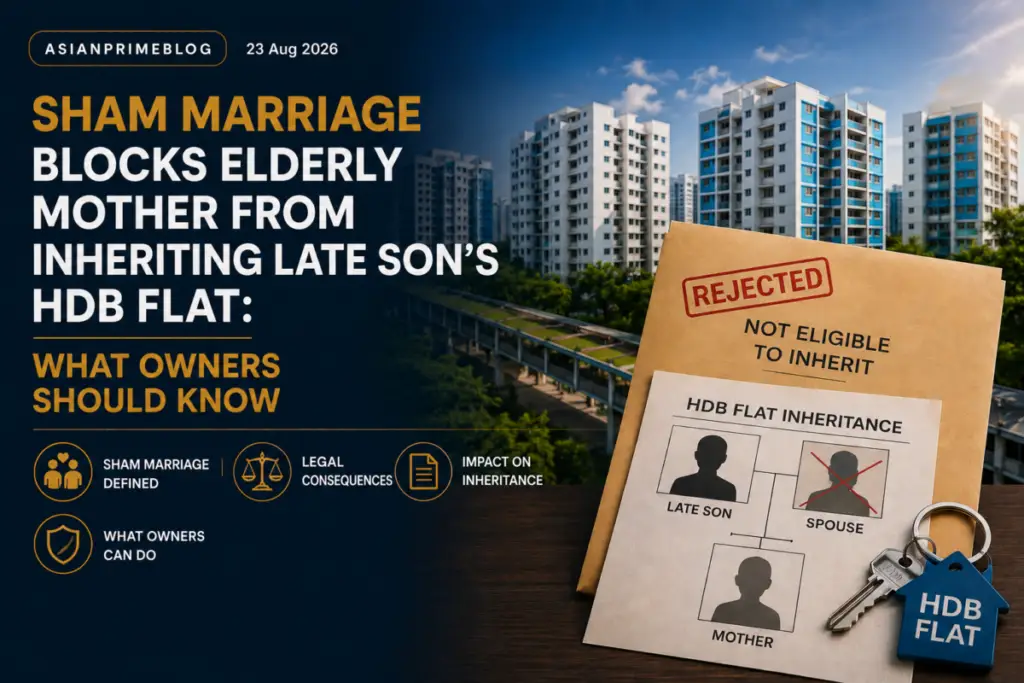
Sham Marriage Blocks Elderly Mother From Inheriting Late Son’s HDB Flat: What Owners Should Know
A 74-year-old woman could not deal with her late son’s HDB flat for seven years, all because he had entered into a fake marriage with a Vietnamese woman who vanished soon after. Writing in The Straits Times, Invest Editor Tan Ooi Boon highlights at least three cases involving the estates of men who entered into fake unions, and the lessons for property owners on wills, nominations and CPF.
Unable to Deal With Flat
Sham Marriage Cases 2024 to 2025
Jail Penalty
CPF Received by Wife
The Case of the Vanished Wife
A 74-year-old woman could not deal with her late son’s HDB flat for seven years because he had entered into a fake marriage with a Vietnamese woman who vanished soon after. As the 45-year-old man did not leave a will, his mother, who lives in the flat, had problems getting approval to manage it because his named spouse would have priority in handling the matter. As the wife could not be found, the mother lived in limbo for seven years, because half the property could go to the wife if there were a dispute.
In the end, the mother sought a court order to nullify the marriage. Due to the exceptional circumstances of her case, the High Court granted her request on the grounds of “public policy” so that her son’s wife could not stake a claim to his assets.
All these marriages happened before 1 October 2018. Since that date, families have been able to use a law under the Women’s Charter to nullify sham marriages that are done to gain immigration advantage. The number of sham marriages dropped from 41 cases in 2024 to just 15 in 2025, as a stiff penalty of up to 10 years in jail awaits those who are caught. Many offenders were nabbed as these “couples” did not live together after the wedding.
How the Court Finally Resolved It
The sham wedding took place in 2013, after the man was promised a lump sum of S$3,000 and a monthly payment of S$400. But he soon realised he had been duped when he stopped receiving his monthly payment after his Vietnamese “wife” became unreachable. Worried, he told his family the truth during a family dinner and later took their advice to make a police report. He stated in the report that his wife was not at home and was unreachable, that he did not have any photographs of her and did not remember what she was last wearing.
He died four years later in 2017, though the circumstances relating to his death were not disclosed. As he did not leave behind a will, his mother and his “wife” would be entitled to share his flat equally.
In 2022, the mother applied for a court order to declare her late son’s marriage void. She also published a notice of the legal action in a Vietnamese newspaper. To support her case, she and her three other children filed statements with the court saying they had never met the “wife”. None of them had been invited to a wedding, and they could not even find any photographs of the couple. Neither did the family members know who the two witnesses to the marriage were. As a result of the family’s statements, the High Court found that the marriage was a sham and granted the mother’s application to have it declared void in 2025.
The Divorcee’s Secret Marriage
In the second case, a divorcee married a Vietnamese woman in January 2011 but did not tell his family. He was mired in debt because of his failure to sell his HDB flat, in which he had a 14 per cent stake.
He died about one year after his marriage. His family became aware that he had a “wife” only when they received a letter from the Insolvency and Public Trustee’s Office informing them that the “wife” would be entitled to a portion of his CPF because he had not made a nomination.
As the family had no information on the “wife”, a notice was published in The Straits Times to notify the potential claimant. The family later found out from the Immigration and Checkpoints Authority that the “wife” had been deported in 2011 after she was arrested for vice activities. The divorcee’s adult son subsequently applied to the High Court to have his late father’s marriage declared void. The court declined his application, noting that he should instead apply to the Family Justice Courts for letters of administration to manage his father’s estate.
A Will That Excluded the Wife
There was no need to declare the third sham marriage void because the husband had set his own affairs in order by leaving a will stating that his “wife” would not be entitled to his HDB flat. Unlike the other two cases involving foreign spouses who vanished, the Chinese national wife in this case lived with the man. But the man claimed that he had married her out of sympathy so she could stay in Singapore as a “study mama” to care for her daughter.
In his will, which was signed five days after his left foot was amputated due to diabetic complications, he stated he did not wish to give his three-room HDB flat and other potential properties to his wife. Instead, he gave the flat to his half-sister. He told his close friend, who helped him get the will drawn up, that this sister deserved the flat because she had gone through a hard life and was poorer than him and his siblings.
He died barely two weeks after the will was done. His widow, who did not visit him in the hospital, contested the will, claiming it was done under suspicious circumstances without the presence of lawyers or doctors. The High Court found that the man was not suffering from any kind of mental illness, as he was in the hospital due to his diabetic condition. On the day when he signed his will, his daily medical records showed that he was “alert, comfortable, oriented to time, place and person and with stable vital signs”.
The CPF Trap: Why a Will Alone Is Not Enough
While the widow failed in her bid to declare the will void, she did not leave empty-handed. She received about S$40,000 from the man’s Central Provident Fund account.
This happened because the man did not make any nominations for his CPF savings, which cannot be distributed according to his will. When there is no nomination, the money in CPF will be distributed according to the intestacy law, which would give his spouse the right to his fund.
Even if the man had made a nomination, his marriage would have rendered the existing nomination void too. What this means is that those who marry later in life should make fresh CPF nominations and wills for their new families.
Frequently Asked Questions
What happens to an HDB flat if the owner dies without a will?
Without a will, the flat is distributed under intestacy law. A legal spouse would typically be entitled to a share, and would also have priority in managing the estate. In the case highlighted, the mother could not deal with her late son’s flat for seven years because his sham-marriage spouse could not be located and half the property could go to her if there were a dispute.
Does a will cover CPF savings?
No. CPF savings cannot be distributed according to a will. They pass by CPF nomination, or under intestacy law if no nomination exists. In one case, a widow received about S$40,000 from her late husband’s CPF despite his will explicitly excluding her from his HDB flat, because he had not made a CPF nomination.
Does marriage affect an existing CPF nomination?
Yes. Marriage renders an existing CPF nomination void. Those who marry or remarry later in life should make fresh CPF nominations and wills for their new families, alongside reviewing how their property is held.

Buying or selling an HDB flat?
Whether it is a BTO application, a resale purchase or timing your sale, I can pull recent transactions for your block and give you an honest read on where you stand.