
Singapore Landed Property Outlook 2026
Property Guide | AsianPrime Properties | August 2026
Singapore Landed Property Outlook 2026: Why Landed Prices Reached a Record High
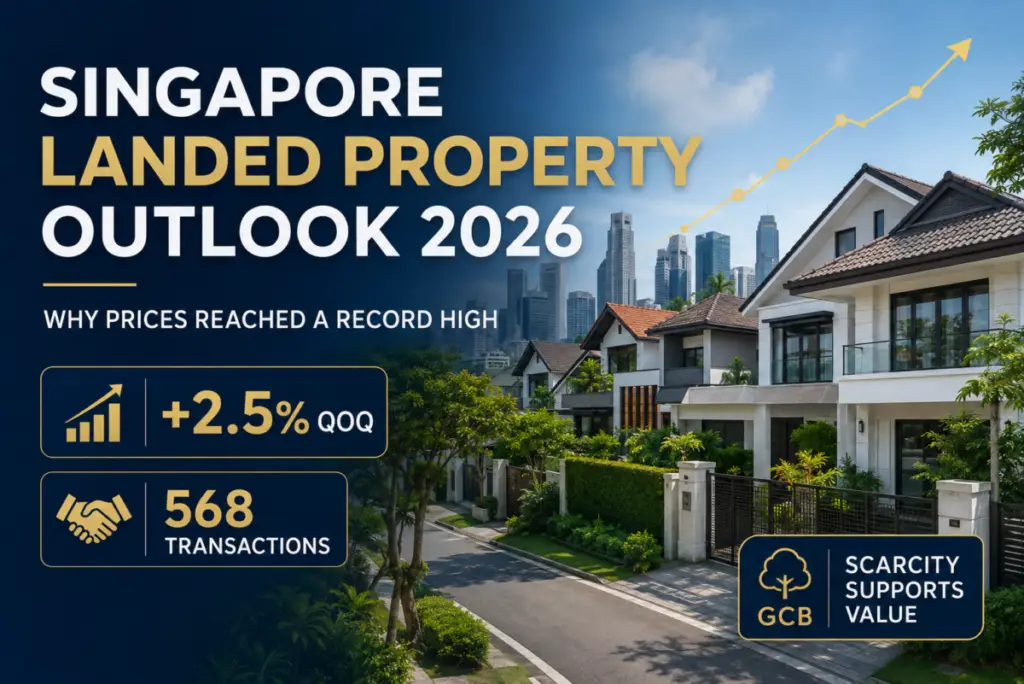
Singapore landed property prices rose 2.5% quarter-on-quarter in Q2 2026 to a record high as buyers returned to scarce freehold assets. Transaction volume also increased, while Good Class Bungalow deal activity firmed, although the segment remains thin and can be influenced by a small number of large transactions.
Q2 QoQ price rise
Q2 transactions
GCB caveats in Q2
Landed price index
What Happened to Landed Prices in Q2 2026?
The landed residential price index rose 2.5% quarter-on-quarter in Q2 2026, reversing the 0.4% decline recorded in Q1 and reaching a record high.
This made landed homes one of the strongest private residential segments during the quarter. The H2 2026 market outlook discusses how landed strength fits into the broader selective market.
Did Transaction Volume Also Increase?
Yes. About 568 landed homes changed hands in Q2, up from 512 in Q1, an increase of around 10.9%.
The combination of higher prices and higher volume suggests renewed buyer interest rather than a price move caused only by inactivity.
What Happened in the Good Class Bungalow Market?
Seven GCB caveated deals were recorded in Q2, up from 4 in Q1. The average GCB land rate rose to about $2,341 psf from $1,803 psf.
The quarter’s largest highlighted deal was a Nassim Road GCB at $64.9 million.
Why Are Landed Homes So Resilient?
Supply is structurally limited. Landed homes, especially freehold properties in established locations, cannot be replicated at the same pace as condominium units.
This scarcity can support values when affluent owner-occupiers and long-term buyers compete for a relatively small pool of suitable properties.
What Foreign Buyer Restrictions Apply?
Under the Residential Property Act, foreigners generally cannot purchase landed residential property in Singapore without prior approval from the Land Dealings Approval Unit (LDAU). Singapore Permanent Residents may apply to buy landed property for owner-occupation under certain conditions, but approval is not guaranteed.
Only Singapore Citizens can freely purchase landed residential property. These restrictions further limit the buyer pool and reinforce scarcity in the segment.
Does a Record Index Mean Every Landed Home Is Rising?
No. Landed property is highly heterogeneous. Plot size, road, shape, tenure, frontage, planning potential, condition and micro-location can create large price differences between nearby houses.
The index can also move significantly because the segment has relatively thin transaction volume and a few trophy deals can influence averages.
What Should Landed Buyers Focus On?
Beyond the purchase price, buyers should review land attributes, redevelopment potential, planning constraints, road and drainage conditions, renovation or rebuilding cost and the likely long-term buyer pool.
The value of a landed purchase often depends as much on the land as on the existing building.
AsianPrime View
Landed property remains structurally supported by scarcity, but buyers should not treat every house as a proxy for the index. Strong assets can remain resilient while compromised plots or over-priced homes take longer to transact.
For buyers, detailed site-level due diligence matters more than broad market momentum.
Frequently Asked Questions
Did landed property prices rise in Q2 2026?
Yes. The landed price index rose 2.5% quarter-on-quarter to a record high.
How many landed homes sold in Q2 2026?
About 568 transactions, up from 512 in Q1.
How active was the GCB market?
Seven caveated GCB deals were recorded in Q2, compared with 4 in Q1.
Can foreigners buy landed property in Singapore?
Generally no. Under the Residential Property Act, foreigners need LDAU approval, and Singapore PRs may apply for owner-occupation only. Only Singapore Citizens can purchase freely.
Does a record landed index mean every property is expensive?
No. Landed values vary widely by land size, tenure, exact location, condition and redevelopment potential.

Looking at landed or Good Class Bungalow property?
This end of the market moves on relationships and off-market listings as much as on published data. Happy to talk through what is genuinely available.